


Our first product, the Arm AGI CPU, is designed for the performance, scale, and efficiency demands of AI data centers. The Arm AGI CPU is designed to address a growing group of customers who want to deploy high-performance, energy-efficient compute without the cost and complexity of building their own silicon. It is optimized for a range of workloads, including general-purpose cloud computing, AI head nodes used in combination with AI accelerators such as GPUs, and emerging agentic AI applications, where performance, scale, and efficiency are critical.
Investor Relations
Message from Arm CEO—SoftBank Group Report 2026
Capturing AI Demand:
Arm’s Business Model Expansion
and Growth Strategy
Board Director, SoftBank Group Corp.
CEO and Director, Arm Holdings plc
CEO, SoftBank Group International
Rene Haas

Expanding the business model through a new chip business
Arm is the world’s most pervasive compute platform, providing the foundational technology that powers billions of devices across smartphones, data center servers, automotive systems and IoT products. At the core of our success is a highly scalable business model, built on licensing our technology designs and earning royalties on every chip that incorporates Arm-based CPUs.
Arm has two main revenue streams. Customers pay an upfront license fee to access Arm’s technology and develop their own chips, and Arm earns a royalty on each chip shipped. Given the long development cycles of semiconductors, license revenues today create a highly predictable stream of future royalties, with many chips remaining in production for a decade or more.
The business growth of this model is driven by the expansion of semiconductor markets, Arm’s increasing share, and rising chip complexity, which drives greater use of Arm technology per device. As workloads become more demanding—particularly with the growth of AI—customers are adopting more advanced Arm technology, such as Armv9, as well as Arm Compute Subsystems (CSS), which combine multiple Arm technologies, both of which support higher royalty per chip over time.
Building on this foundation, Arm has entered a new phase of its strategy. In fiscal 2025, we expanded our business model to include the development and sale of complete chips, starting with the Arm AGI CPU, a data center CPU for AI workloads. This reflects a natural evolution of our platform, as some customers increasingly seek fully integrated solutions from Arm.
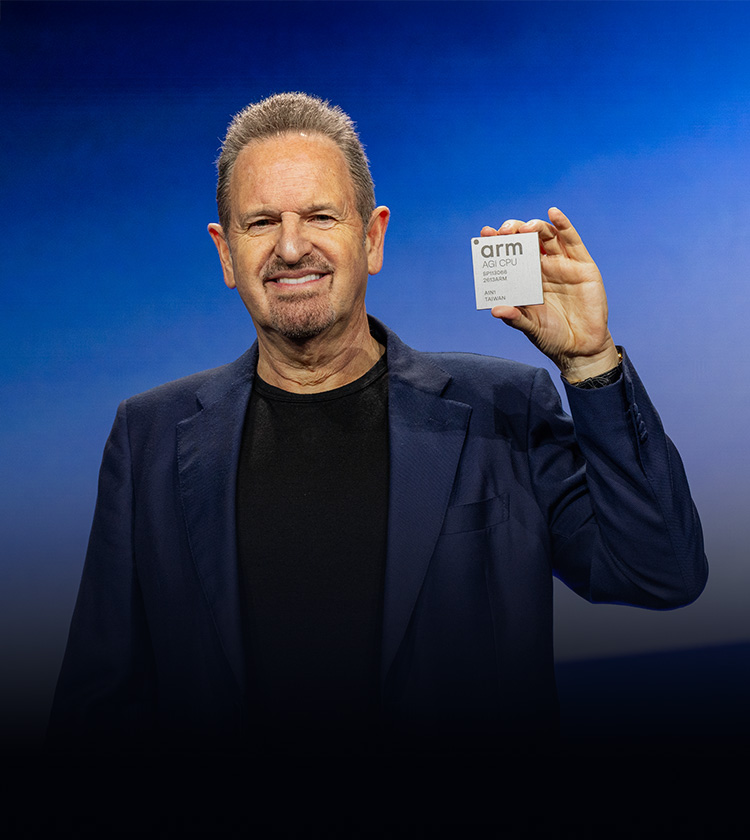
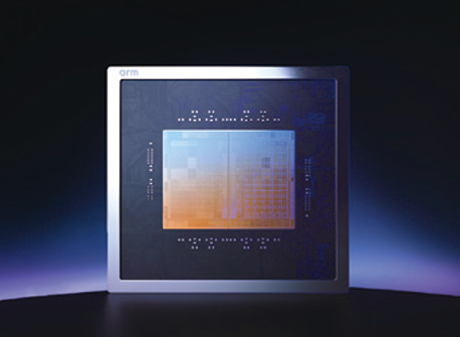
Our first product, the Arm AGI CPU, is designed for the performance, scale, and efficiency demands of AI data centers. The Arm AGI CPU is designed to address a growing group of customers who want to deploy high-performance, energy-efficient compute without the cost and complexity of building their own silicon. It is optimized for a range of workloads, including general-purpose cloud computing, AI head nodes used in combination with AI accelerators such as GPUs, and emerging agentic AI applications, where performance, scale, and efficiency are critical.
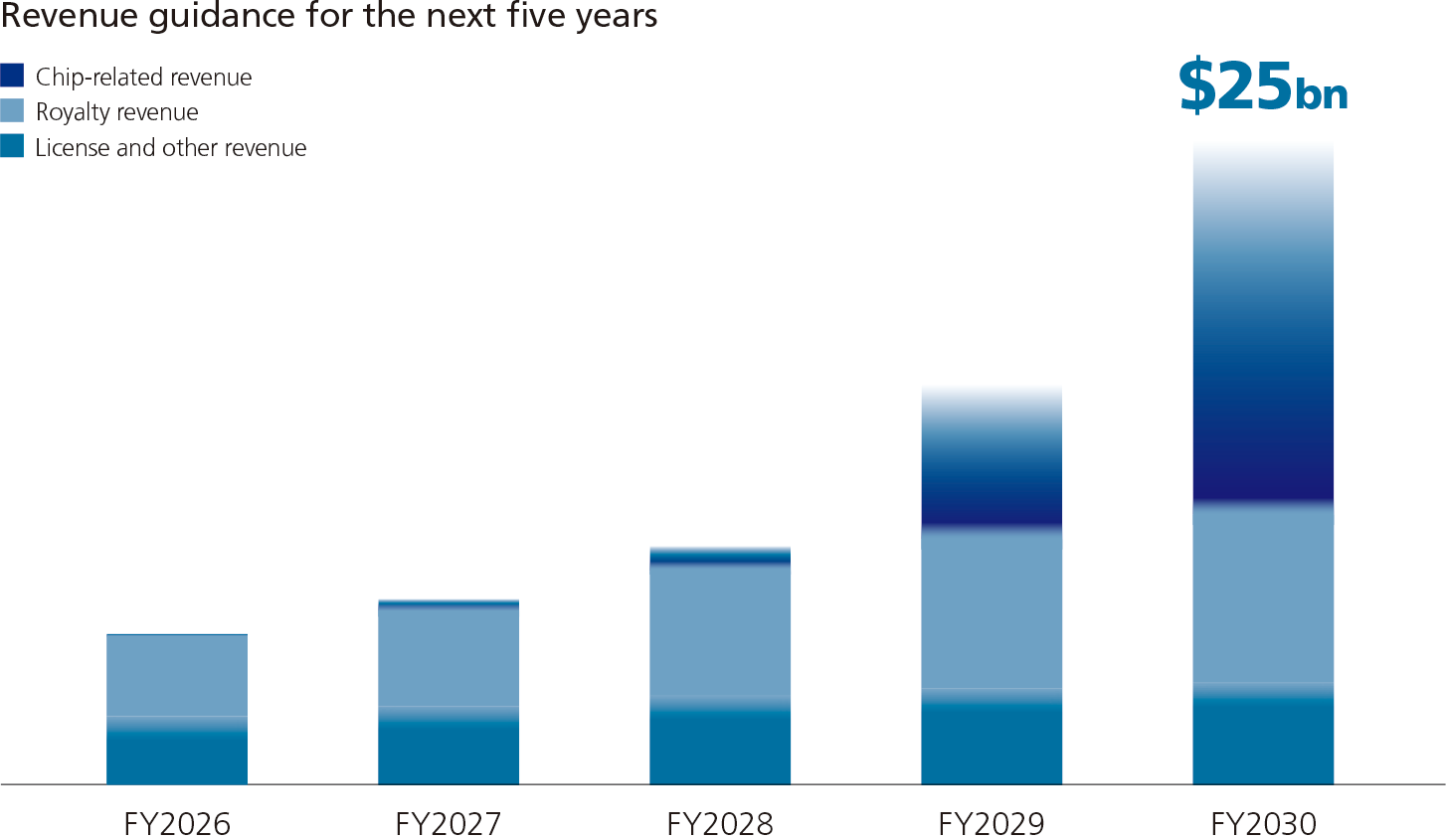
Looking ahead, we have provided five-year guidance reflecting the combined strength of our IP and CSS businesses and chip businesses. By fiscal 2030, we expect to reach approximately $25 billion in annual revenue, comprising around $10 billion from IP and CSS and in excess of $15 billion from chips, supported by strong demand across AI-driven markets.
Fiscal 2025
performance overview
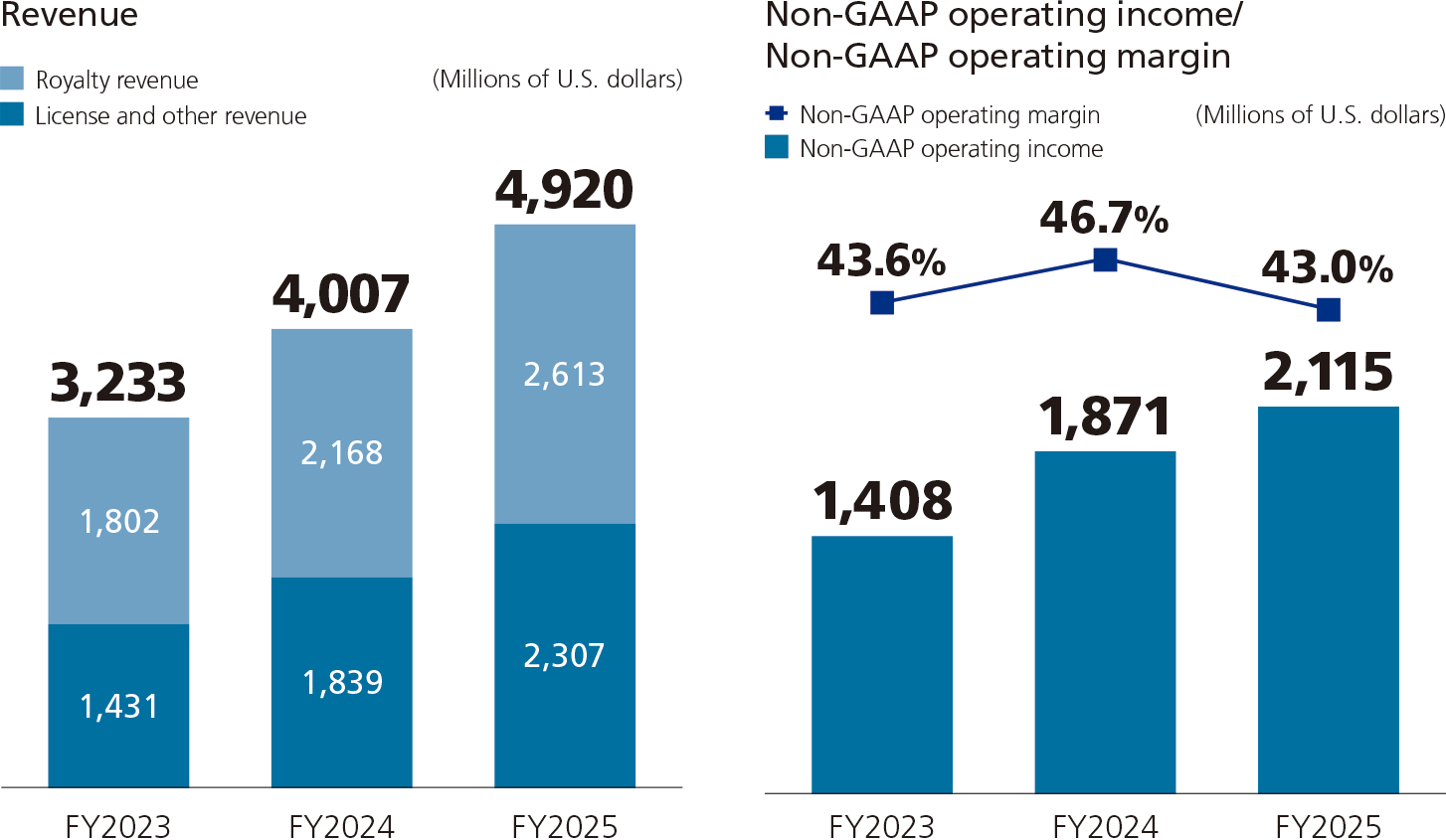
Arm delivered another year of strong performance in fiscal 2025, reflecting continued momentum across our key end markets and increasing adoption of our latest technologies. In fiscal 2025, Arm achieved record revenue of $4,920 million, growing 22.8% year-on-year, driven by both royalty revenue and license and other revenue growth.
Royalty revenue grew 20.5% year on year to $2,613 million, driven by end-market demand, share gains, and increased content per chip. The transition from Armv8 to Armv9 remained a key driver, with Armv9 commanding significantly higher royalty rates. Adoption of CSS also accelerated, particularly in high-performance applications, further increasing royalty per chip. License and other revenue increased 25.4% year on year to $2,307 million, supported by strong demand for next-generation chip designs and multi-year agreements as customers aligned with Arm’s roadmap for AI-enabled computing. The continued shift toward subscription-based licensing models, such as Arm Total Access, also contributed to improved visibility and long-term growth.
Growth was broad-based within end markets. In smartphones and consumer devices, demand was supported by increasing AI integration at the edge. In cloud computing, Arm continued to gain share as hyperscalers and enterprise customers deployed Arm-based processors. Automotive also remained a strong growth area, with rising compute requirements in advanced driver-assistance systems and early autonomous applications.
In fiscal 2025, we continued to increase investment in research and development to support our long-term strategy, with R&D expenses rising 42.6% year on year to $1,911 million. This reflected progress in developing next-generation CPU architectures, expanding our CSS portfolio, and introducing our first chip product line. Importantly, much of the required investment for our future roadmap— including our chip strategy—has now been made, positioning us well for operating leverage in the coming years. Despite this increased investment, Arm remains highly profitable, with a gross margin of 98.2% and an operating margin of 43.0%.
Overall, our fiscal 2025 performance reinforces the strength of Arm’s business model and the durability of our growth drivers, positioning us well for sustained long-term growth.
-
Notes:
-
1. Arm revenue presented in this section is based on figures disclosed by Arm Holdings plc in accordance with U.S. GAAP.
-
2. Research and development expenses, gross margin, and operating margin are non-GAAP measures as defined by Arm Holdings plc and refer to adjusted value of each.
Key Growth Markets: Edge AI, Cloud AI and Physical AI
Arm’s growth is increasingly driven by the rapid adoption of AI across three major domains. Each represents a significant and expanding market opportunity, with Arm’s technology playing a central role.
Edge AI
Smartphones, PCs and IoT devices
Edge AI includes smartphones, personal computers, and a wide range of consumer and embedded devices that run AI workloads locally. Arm already has a leading position in this market, with our technology used in more than 99% of smartphones and a high share across many other consumer devices.
As AI capabilities become standard, demand for higher performance and energy efficiency is increasing. This is driving the transition to Armv9 and the adoption of CSS, enabling more advanced functionality while reducing development time. We also expect expansion into new categories such as personal AI computing and intelligent edge systems, supporting both unit growth and higher royalty rates.
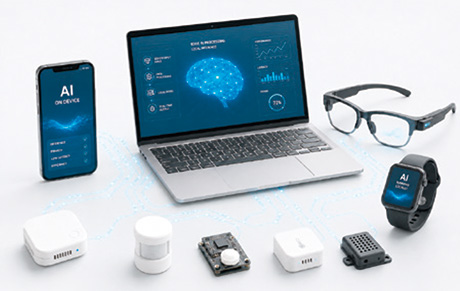
Edge AI includes smartphones, personal computers, and a wide range of consumer and embedded devices that run AI workloads locally. Arm already has a leading position in this market, with our technology used in more than 99% of smartphones and a high share across many other consumer devices.
As AI capabilities become standard, demand for higher performance and energy efficiency is increasing. This is driving the transition to Armv9 and the adoption of CSS, enabling more advanced functionality while reducing development time. We also expect expansion into new categories such as personal AI computing and intelligent edge systems, supporting both unit growth and higher royalty rates.
Cloud AI
Data centers and networks
Cloud AI is the fastest-growing business unit of our business and is expected to be the largest contributor to revenue growth over the next five years. This includes hyperscale data centers, enterprise infrastructure, and networking equipment supporting AI training and inference.
The role of the CPU in AI data centers is becoming increasingly important. As workloads evolve—particularly with the rise of agentic AI—demand for CPU performance and efficiency is rising significantly. Arm is well positioned, with its technology already widely deployed by leading cloud providers. Our new chip strategy further expands this opportunity by delivering high-performance, energy-efficient CPUs to customers who do not wish to develop their own.
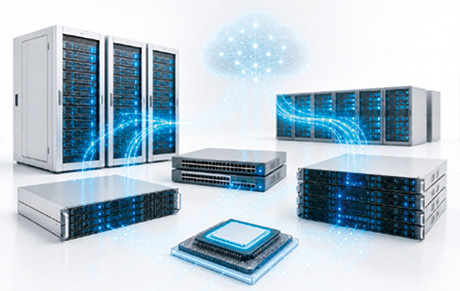
Cloud AI is the fastest-growing business unit of our business and is expected to be the largest contributor to revenue growth over the next five years. This includes hyperscale data centers, enterprise infrastructure, and networking equipment supporting AI training and inference.
The role of the CPU in AI data centers is becoming increasingly important. As workloads evolve—particularly with the rise of agentic AI—demand for CPU performance and efficiency is rising significantly. Arm is well positioned, with its technology already widely deployed by leading cloud providers. Our new chip strategy further expands this opportunity by delivering high-performance, energy-efficient CPUs to customers who do not wish to develop their own.
Physical AI
Autonomous vehicles and robotics
Physical AI includes autonomous vehicles, robotics, and industrial systems where AI operates in real-world environments. This is an emerging market with significant long-term potential.
In automotive, Arm is already widely used in driver-assistance and infotainment systems and is becoming central to the development of software-defined vehicles. As autonomy increases, so does compute per vehicle, driving higher content and royalties, supported by CSS. In robotics, similar trends are emerging, with growing demand for efficient, high-performance compute platforms.
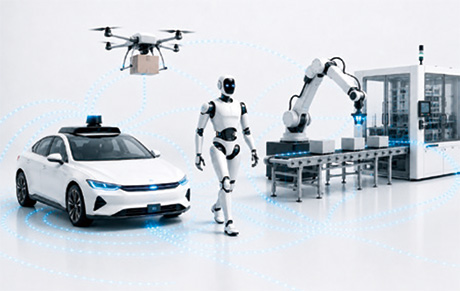
Physical AI includes autonomous vehicles, robotics, and industrial systems where AI operates in real-world environments. This is an emerging market with significant long-term potential.
In automotive, Arm is already widely used in driver-assistance and infotainment systems and is becoming central to the development of software-defined vehicles. As autonomy increases, so does compute per vehicle, driving higher content and royalties, supported by CSS. In robotics, similar trends are emerging, with growing demand for efficient, high-performance compute platforms.
-
This page is based on the information as of July 27, 2026.
-
Click here to check the company names or abbreviations used in this page.
