Fiscal 2025 in review
Balancing large-scale investments with financial discipline
Fiscal 2025 marked the beginning of a full-scale global shift toward AI. As AI continues to evolve and the companies at its core grow significantly, companies including SBG, faced defining choices: which partners to work with and what frameworks to build for the future.
Against this backdrop, SBG steadily executed strategic investments across key AI domains, including our large-scale commitment to OpenAI, as well as investments in AI chips, AI infrastructure, and physical AI. These efforts were supported by the growth of our portfolio assets and the strong relationships we have built with financial institutions and investors. As CFO, the progress we made during the year reinforced my confidence in our strategy.
Performance summary
NAV, a key indicator for SBG as an investment holding company, reached a record high of ¥40.1 trillion as of March 31, 2026, driven by our holdings in Arm and OpenAI. LTV, an indicator of financial soundness, improved by 1 percentage point from the previous fiscal year-end to 17.0%, and our cash position increased by ¥0.2 trillion to ¥3.5 trillion. Improving our financial soundness while advancing large-scale investments was one of our major achievements in fiscal 2025.
Net income attributable to owners of the parent reached a record high of ¥5.0 trillion, the highest ever recorded by a Japanese company. This result has been well received by investors. At the same time, as an investment holding company, we believe evaluating accounting profit in isolation provides an incomplete picture. Our primary focus remains on how our current investments will translate into NAV growth five or 10 years from now. We would like investors to view this result as a milestone in our long-term growth trajectory.
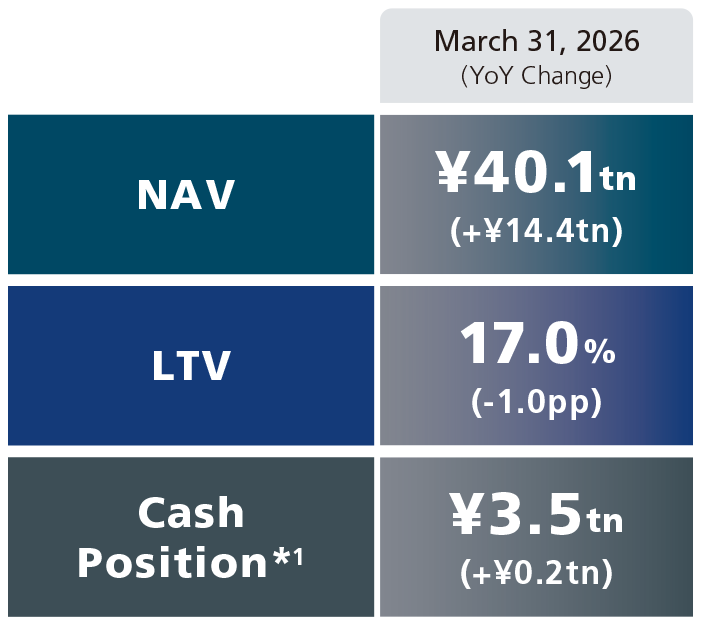
NAV, a key indicator for SBG as an investment holding company, reached a record high of ¥40.1 trillion as of March 31, 2026, driven by our holdings in Arm and OpenAI. LTV, an indicator of financial soundness, improved by 1 percentage point from the previous fiscal year-end to 17.0%, and our cash position increased by ¥0.2 trillion to ¥3.5 trillion. Improving our financial soundness while advancing large-scale investments was one of our major achievements in fiscal 2025.
Net income attributable to owners of the parent reached a record high of ¥5.0 trillion, the highest ever recorded by a Japanese company. This result has been well received by investors. At the same time, as an investment holding company, we believe evaluating accounting profit in isolation provides an incomplete picture. Our primary focus remains on how our current investments will translate into NAV growth five or 10 years from now. We would like investors to view this result as a milestone in our long-term growth trajectory.
-
*1 Cash position = Cash and cash equivalents + short-term investments recorded as current assets + bond investments + undrawn borrowing capacity. The borrowing facilities were fully drawn as of March 31, 2026. Excludes the outstanding balance of SB Northstar’s prime brokerage loan of ¥801.9 billion, which is collateralized primarily by a portion of bond investments included in SBG’s cash position.
PayPay’s listing
The value of our holdings is supported by the growth of many of our portfolio companies. In March 2026, PayPay successfully listed on the Nasdaq Global Select Market. PayPay stands out as a particularly meaningful example: a business we built from scratch and incubated into a listed company with a market capitalization approaching ¥2 trillion. Inspired by the entrepreneurial spirit of Mr. Son—our CEO—talented, highly motivated people from across the Group came together to launch and grow this new business. In this sense, PayPay also symbolizes SBG’s longstanding DNA. Looking ahead, I expect PayPay to grow into an even more attractive company by building on its strong business foundation in Japan, expanding globally, and further broadening its range of financial services.
Fiscal 2025 investment and funding activities
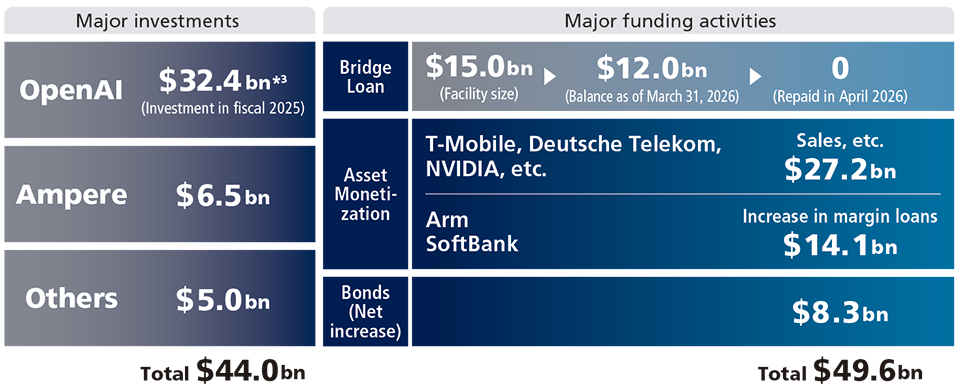
In fiscal 2025, we executed investments totaling $44.0 billion, including follow-on investments in OpenAI and the acquisition of Ampere. To finance these investments, we arranged bridge loans*2 totaling $15.0 billion and raised an additional $49.6 billion through the sale of holdings and the issuance of bonds. Although both the investments and the financing were substantial in scale, their execution was entirely manageable, as our leverage remained well within a safe range relative to our NAV.
In pursuing disciplined leverage, our role is to define where that safe range lies. Once we establish this comfort level, we can approach financing transactions from the same perspective as financial institution lenders and bond investors. We are confident the transactions we undertook in fiscal 2025 were managed in a way that these lenders and bond investors would also view as secure.
Our approach to financing large-scale investments
We always maintain ample liquidity so that we can move quickly on investment opportunities. However, the optimal timing for monetizing our holdings does not necessarily coincide with the timing of new investments. Therefore, we believe the most effective approach for large-scale investments is first to enter into a bridge facility with financial institutions for a defined period and then to arrange the optimal takeout financing within that period. We share this approach with our key financial institutions. With certain banking groups, we begin preliminary financing assessments in the early stages of evaluating an investment. As a result, by the time a transaction is announced, the financing framework has already been established, leaving only administrative steps before drawdown. This ongoing and constructive dialogue enables us to secure financing swiftly even for large-scale transactions.
The foundation of these relationships lies in SBG’s unwavering commitment to upholding our financial policy—first, to keep LTV below 25% under normal circumstances, with an upper threshold of 35% in extraordinary circumstances and, second, to maintain a sufficient cash position to cover at least two years’ worth of bond redemptions. For our many stakeholders, including retail bond investors, simplicity and clarity in financial policy are paramount. At the same time, this policy addresses both the underlying capacity of our balance sheet and the liquidity needed to meet upcoming debt obligations. It also underpins the high regard financial institutions have for our financial management. From my perspective, our ability to execute large-scale financing is a direct reflection of this discipline.
Fiscal 2025 investments and funding
Making investment decisions and managing risk in line with our financial policy
SBG does not operate with a fixed investment budget. Investment opportunities can arise at any time and in any form. Our financial policy is the benchmark for determining the scale of investment we can accommodate. If a transaction can be pursued while maintaining financial soundness as defined by our financial policy, it receives a “green light,” allowing us to act decisively and capture the investment opportunity. As long as our financial policy is maintained, our holdings provide sufficient capacity, enabling us to begin financing discussions immediately with financial institutions. This means that by the time an investment transaction is announced, it has already received the green light. Any transaction that would cause LTV to exceed the level set out in our financial policy would naturally require further deliberation.
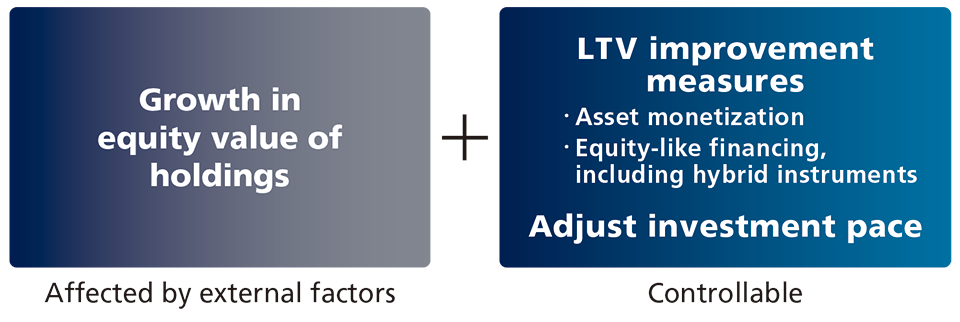
Our credit is supported by NAV growth— as NAV grows, we gain greater capacity to pursue growth proactively. However, NAV is significantly affected by market conditions and is not something we can fully control. By contrast, LTV is something we can directly control. Even if market conditions deteriorate, it is important that we ensure financial soundness by maintaining discipline over investment activities and continue communicating this discipline transparently to our stakeholders.
If concerns arise that LTV could deteriorate due to changes in the external environment, we consider measures to control the numerator of LTV by limiting the relative increase in net debt. We maintain multiple levers to improve LTV, including monetizing holdings through the sale of assets or asset-backed financing, or securing funding with certain equity-like characteristics hybrid financing. Importantly, as an investment holding company investing on its own account, we continuously evaluate whether to hold or monetize assets. Anticipating external volatility and preparing these contingency measures ensures our financial management remains nimble.
Approach to LTV management
Fiscal 2026 investment and financial policy
Our financial policy will not change in fiscal 2026, and we will continue to maintain financial soundness. At the same time, how we address large-scale investments remains a key priority. Our $30.0 billion follow-on investment in OpenAI is one of the major transactions that has already been announced. Of the $30.0 billion commitment, $20.0 billion has already been funded in two tranches in April and July 2026, and the remaining $10.0 billion is scheduled to be paid in October 2026.*4 In addition, the $5.4 billion acquisition of ABB’s robotics business and the $3.1 billion acquisition of DigitalBridge are scheduled to be completed by the end of 2026.
Bridge loans and takeout financing
To support these investments, we arranged a $40.0 billion bridge loan facility in March 2026. Of this amount, $20.0 billion has already been drawn in connection with the follow-on investments in OpenAI, and we plan to borrow an additional $10.0 billion in line with the remaining payment scheduled for October 2026. We will repay and refinance this bridge facility, which matures in March 2027, by combining various forms of takeout financing.
For the majority of the takeout financing, our primary focus will be on asset-backed financing leveraging our portfolio. In addition to our listed holdings such as Arm and SoftBank, our holdings in OpenAI could provide financing capacity in the future. Selling holdings is also an option, but doing so also means forfeiting their future upside. For this reason, asset-backed financing should be prioritized as long as conditions allow. That said, to further strengthen our financial soundness, we may also monetize certain assets through sales. At the same time, given the ample financial capacity we currently have, establishing loan facilities and issuing bonds are also important takeout options. For bonds, we will fully leverage both domestic and international markets and pursue an optimal mix of funding sources.
Continuing growth investments while controlling financial risk
For AI infrastructure investments, such as power and data centers, we will pursue debt financing through project finance as nonrecourse financing that does not impact our LTV. Building a financing structure that allows lenders to participate with confidence requires considerable effort, but we will establish one under which debt can be repaid comfortably using the cash flows generated by the project. In this case, SBG’s financial risk will, in principle, be capped at its equity contribution. With respect to DigitalBridge, the balance sheets and debt of its investees will not, in themselves, directly impact SBG’s credit profile post-acquisition.
In fiscal 2026, we also expect interest costs to rise. However, for an investment holding company, financing is essentially the procurement cost of our investment capital. Our fundamental approach is to outpace the interest expense of debt financing through the equity returns generated by the underlying assets. Historically, we have achieved equity IRRs that far exceeded the cost of debt financing, such as in our investments in Alibaba and Arm. We have strong confidence in our future investment returns as well. Even if interest costs rise, they will not have a major impact on our business model, and our approach of making necessary investments while maintaining our financial policy will remain unchanged.
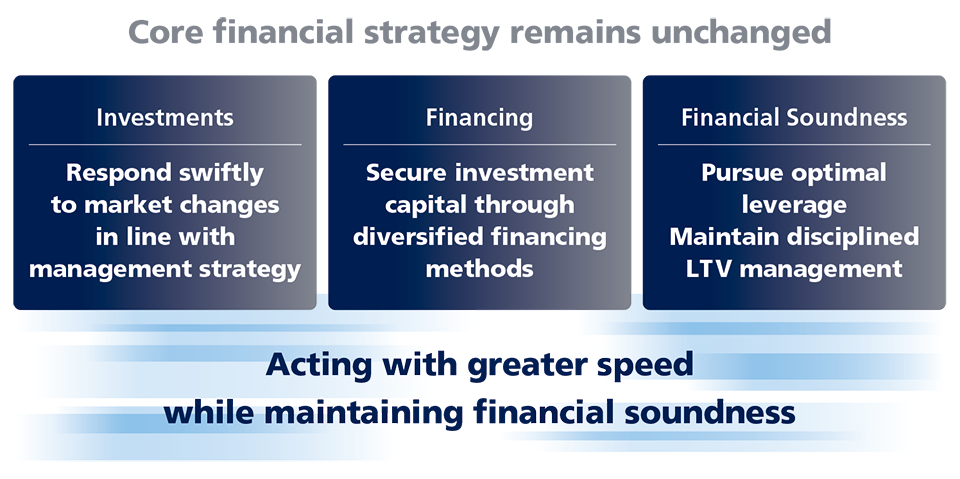
The pace of change continues to accelerate as AI spreads across industries. This is precisely why we must remain grounded in our core principles of financial strategy while building the capability to act with even greater speed when necessary. On the investment side, we will stay closely aligned with SBG’s management strategy and respond swiftly to market changes, maintaining our ability to seize investment opportunities. On the financing side, we will use a variety of methods to secure the capital needed for investment. To maintain financial soundness, we will continue to pursue optimal leverage and rigorously manage LTV. Going forward, we will continue to aim to maximize SBG’s NAV by combining the agility needed to capture growth opportunities with the financial discipline that gives stakeholders confidence.
Financial strategy for fiscal 2026
-
This page is based on the information as of July 27, 2026.
-
Click here to check the company names or abbreviations used in this page.
Related Contents